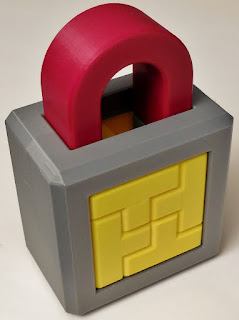
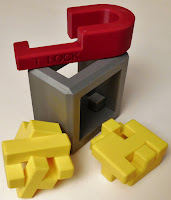
I recently received a Pumpkin that was already cut open with its guts spilled out. At first glance, I looked at its big carved mouth and 3 simple guts and thought – this is going to be easy. It wasn’t. It was surprisingly engaging and entertained me for a considerable amount of time. I didn’t solve it by midnight and it turned into a puzzle.
Pumpkin 1 was designed by Osanori Yamamoto and made by Pelikan Puzzles with a Pear box and Bubinga pieces. It is an apparent cube packing puzzle (i.e., the opening of the box is completely filled and any empty space is hidden within the box).
There are a few ways to address the solving process for these types of puzzles. The first is to find an assembly for the pieces and then test the assembly against the disassembly that is constrained by the opening of the box. This works best when there are a small number of assemblies. They usually have a smaller number of pieces as well as a smaller number of voids in the solved cube. Pumpkin 1’s 3 pieces certainly meet the small number of pieces criteria, but there are 9 voids within the solved puzzle. Playing with the pieces, there seemed to be a surprisingly large number of ways to assemble them within a 3x3x3 space. After solving it, I checked with PuzzleWillBePlayed (PWBP) where it indicated that there are 54 assemblies with only 1 of the assemblies provides a working solution.
Another way to tackle the problem is to determine how the pieces can be inserted within the frame through the restricted opening. However, with Pumpkin 1’s wide open corner, there isn’t much that isn’t allowed. And yet, it’s not easy to get all the pieces in there as an apparent cube.
At one point, I was hoping that I was correct in assuming that it really was an apparent cube puzzle since I had found at least one solution where all the pieces went in, but there was a visible void. While we’re talking about making assumptions, I wasn’t aware of the puzzle’s level while solving and was assuming that it took more than 1 move to remove the first piece, which is true for most puzzles of this type.
I finally decided to tackle this particular puzzle by working it from the other end and testing how pieces may move in sequence to release them from the box. For the first move, does the piece start to come out or does it go further in? Does 1, 2 or all 3 pieces move together at the same time? How would that movement allow another piece to move? Rinse and repeat.
The pieces do allow for some interesting movement. At one point, I discovered an interesting sequence of moves that seemed to have promise. Unfortunately it wasn’t the solution I was looking for. I kept searching for other sequences but couldn’t find anything else even close. I kept going back to that sequence of moves and tried to find ways to tweak it into submission. Sadly I couldn’t find anything else. Even sadder, it was the real solution but I failed to recognize it. As it turned out, I could have solved it before midnight if I had paid better attention. That’s the danger of working outside the box. Sometimes there’s a difference between the virtual world and the real world.
I also learned on PWBP that there are 2 other Pumpkin designs by Osanori – strategically named Pumpkin 2 and Pumpkin 3. After looking at the other 2 designs, I couldn’t find a similar feature that relates them. However, Osinori generates so many designs, I can’t blame him for genericizing the naming process.
On the path of exercising the mind. Expanding developing minds and preserving more mature ones.
Wednesday, April 20, 2022
Wednesday, April 6, 2022
Are You Worthy? – Enter If You Can
And now for something completely different and yet somehow refreshingly exactly the same. In a slight departure from the normal blog fare here at ZenPuzzler, instead of presenting a puzzle, I have the pleasure of presenting a newly released book about puzzles, or more specifically, puzzle boxes.
Enter If You Can, The art of puzzle boxes is a new book by puzzle box collector and designer, Peter Hajek (ISBN 978-1-5272-8215-5). After many decades of research on addiction, Peter finally decided to write a book about his own. Within, Peter shares a wealth of puzzle box knowledge gained from his experience as a longtime collector and his frequent puzzle box hunting expeditions around the world. The book provides a brief history of puzzle boxes, a survey of different puzzle box styles and their tricks, and a cross section of puzzle box designers from around the world. I should warn you that the solutions to several of the puzzle boxes included are revealed and discussed.
The book is well-written, informative, and full of beautiful photos of a large variety of puzzle boxes. Its greatest failure (or strength) is that the reader is left wanting more. In fact, I would have enjoyed an entire encyclopedia on the subject matter with each chapter becoming a book of its own. Of course, this is a characteristic of a well-written book and I’m certainly looking forward to the next one.
The book is available in 2 formats – book only and book with lock. The locked version ensures that the petitioning reader is worthy of receiving the knowledge within and incorporates a strap attached to the back cover that connects to a lock attached to the front cover. Of course it is a puzzle lock that has to be solved to open the book. The lock was designed and made by Master Locksmith, Shane Hales of Halespuzzles.
As of this writing, the book without the lock is available at Cubicdissection and the locked version is available at Puzzle Master. Pelikan Puzzles offers both versions of the book together as a set in case you want the locked copy but also require an easy access version if you feel you may not be worthy. Both versions are also individually available from Grand Illusions.
Wednesday, March 30, 2022
A Particlely Nice Puzzle - XI
How many XI particles can occupy a small planer space? Well, that all depends on the spin and orientation of each XI particle.
XI is a restricted opening 2D packing puzzle designed by Haym Hirsh and made by NothingYetDesigns. The 2 openings in the top permit the XI and anti-XI particles to be injected within the frame. The anti-XI particles are simply XI particles with a 180 degree spin. Although the 2 openings conspire to suggest that both XI and anti-XI particles should be injected, it is not obvious how many of each is required or even if both types are needed. Even if each anti-XI particle cancels out a XI particle as they bounce around and collide with each other, the odd number of particles suggests that the solution will eventually end up as a XI or anti-XI puzzle. I leave it up to you to find out which.
Needless to say, the particles need to be added in a specific order and potentially rotated as they are entangled. It’s nice that the top is clear so that you can see what you are doing. Of course, you have to perform all those particle movements and rotations using the 2 openings. Fiddly, but not that difficult. However, if you regularly refer to your digits as sausages, you may find the physics of manipulating small particles more of a challenge.
XI is made with laser cut acrylic and has a nice heft to it. The use of washers to elevate the clear top ensures that the 5 particles move nicely within the frame. The puzzle information engraved on the top is also well done and useful for distinguishing the puzzle from other restricted opening 2D packing puzzles by Haym from NothingYetDesigns.
Wednesday, March 23, 2022
Going Postal - Letter Box
Your task - to stuff a Letter Box with letters until it is completely full. Oh! - and there are 2664 assemblies. And you can’t just shove them in, some have to be rotated while they are in the box. You may even find yourself stuck and frustrated if you’re not careful.
All the letters that you will be stuffing in Letter Box are copies of the L tromino - 9 of them. They all have to be inserted through the small slot. When solved, the 9 L trominos will completely fill the Letter Box.
Letter Box, designed by Pit Khiam Goh, was made by Cubicdissection and released in December 2020. The box is made from Walnut and each of the L trominos is made from a different exotic wood: Wenge, Canxan, Jatoba, Zebra, Bloodwood, Purple Heart, Katalox, Chakte Viga, and Ash. It’s especially nice that each of the L tromino pieces is made from a single piece of wood. In addition to the slot that permits the L trominos to pass, there are 2 additional holes that can be used to view and manipulate the pieces within the box.
There are many ways to tackle a puzzle. Since this puzzle has 2664 assemblies, I wouldn’t recommend an exhaustive approach to try each one until you find one that works. Even if you found a working assembly, it may not be obvious since the solution requires rotating pieces within the box. For this puzzle, a better approach would be to start at the other end and envision how the pieces would be removed from the box. How would the first piece come out? Then with the first piece out, how would the second piece come out? Using this approach, I was able to find a workable assembly and determine the rotations needed to solve Letter Box. Not overly difficult but a very nice challenge.
Wednesday, March 16, 2022
Puzzling Preparation Purgatory – Helical Bits and Pieces
I recently had the opportunity to acquire some nice helical puzzles from one of the Two Brass Monkeys. I’ve been eyeing these types of puzzles for years and finally acquired some when a set became available on Puzzle Paradise. Included in the set were: HeLLical Burr, Oliver Twist, Twiddle Dee, Twiddle Dum, and Dodekastar (improved). The first 4 were designed by Derek Bosch and are from his line of helical burrs, which he has been expanding over many years. Although Dodekastar is not a helical burr, it is a great puzzle designed by Yavuz Demirhan and tweaked by the Two Brass Monkeys to be more difficult. A nice little additional fidget puzzle was also included, which was the only puzzle to arrive already disassembled.
Puzzles arriving in their solved state is a sin and need to be disassembled into purgatory before being redeemed into a solved state. Although a sinful puzzle and one that has been redeemed share the same outward appearance, deep down, you know the difference. Every serious puzzle collector is able to scan their collection and weigh their sins against redemption.
Having received this batch of sinful puzzles, I quickly (or not so quickly) banished the puzzles to purgatory (a nice looking decorative bowl) for all eternity (the average amount of time it takes me to get around to solving puzzles). Most were straight-forward, but one of the Twiddle twins (I really don’t know which is which), was a bit of a challenge. I was also surprised to find out that Dodekastar was a challenge to take apart as well. A lot of movement, but no obvious exit point.
Stay tuned for further updates on these puzzles as they are redeemed and take on their divine forms.
Wednesday, March 9, 2022
Puzzle Of A Year! – 20-22
20-22 is a level 22.02 puzzle announced on Twosday, 22.02.2022, by PuzzleWillBePlayed (PWBP). It was designed by Stéphane Chomine and consists of 2 pieces that fit within a frame. When solved, one side shows the numerals 20 and the other 22.
I always check out the new puzzles released on PWBP and this one caught my eye and interest. I quickly printed a copy with a gray frame and red pieces. One piece has a 2 on each side and the other has a 2 on one side and a 0 on the other. Of course, the frame has some internal obstructions keeping the pieces from simply sliding in. Must be a puzzle.
This puzzle embodies several qualities that facilitate the solving process. The first is the level. At 22 moves, you would expect it to be non-trivial but not too hard. The second is that the piece with a 2 on each side is the same when you rotate it 180 degrees on any axis. That means that you can’t possibly add this piece incorrectly. You just need to figure out which side of the frame it belongs to. Lastly, since the piece with the 0 can go in the frame in four different ways, there are only 4 assemblies to check. With a little experimentation, the complete pas de deux is revealed as the pieces find their final resting place.
A special thanks to all the MPD’rs that unknowingly contributed to this post.
Wednesday, February 16, 2022
X-tra Protection – T Lock
Last week’s blog got me thinking about protection so I thought it might be time to circle back and cover T Lock, the second of Andrew Crowell’s 3D printed burr locks that I recently acquired. It certainly has secured a well-deserved spot in my collection of enjoyable puzzles.
Like Side Lock (www.zenpuzzler.com/2022/01/put-it-to-side-lock.html), T lock has a main frame (for all you old programmers out there), a shackle, and 4 T pieces that are packed in the frame. The pieces are nicely 3D printed in gray, red, and yellow. Since it doesn’t have the fifth piece running side-to-side like Side Lock, I expected it to be slightly easier. Of course, it turned out to be slightly harder. T Lock requires 15 moves to remove the first piece compared to 19 moves for Side Lock, but T Lock requires a rotation, which gives it that boost in difficulty. Recall that puzzle difficulty = cube root of total voxels * pieces * highest piece moves * log(10 + rotations * 100) / 100. {Factors to compensate for things like n-ary inflation have been dropped for simplicity. Compensating factors for piece surface area have also been removed since they are a pain to compute. However, for designers that needlessly increase voxel resolution, these factors should be added back in.}
I’d like to describe how easy the original disassembly was, but it was so long ago I can’t remember. This became all too obvious as I worked to get it back together. In fact, I forgot that a rotation was required, which really is the crux move of this puzzle. Needless to say, accomplishing the solve was a challenge.
The frame has 3 impeding cubies attached inside to help you figure out where you can, or more appropriately, where you can’t, put pieces. These cubies only permit the shackle to be inserted in one orientation, so you can also add the shackle to places where pieces can’t go. With some work, you can then determine where the 4 T pieces go, although I admit to doubting this configuration many times and re-examining it. Trying to get those 4 pieces in the frame took some effort. Once I finally figured out which 2 pieces needed to go in first, I had a devil of a time trying to get them situated in the frame.
Typical Crowell puzzle scenario – struggling to get 2 small pieces in a big open frame. Been there many times. This is where I spent most of the time in the assembly until I finally enjoyed the Aha moment that resulted in not just the first 2 pieces in the frame, but all 4.
T Lock is difficult and very satisfying as an assembly puzzle. Having done it several times now, although not as difficult as an assembly puzzle, attacking it as a disassembly puzzle is interesting as well. You can get copies of T Lock on Andrew’s online store, ARC Puzzles.
Subscribe to:
Posts (Atom)
.jpg)
.jpg)
.jpg)
.jpg)
.jpg)