Pages

Wednesday, February 8, 2023

No Scoop 4U – 4 PAC

4 PAC by Hajime Katsumoto

Continuing the trend of designing restricted-opening packing puzzles with 4 simple looking pieces, Hajime Katsumoto has provided us with 4 PAC.  The box has a single slot opening to permit the pieces to be entered and several poke holes for you to insert your fingers for manipulating the pieces.  However, for this packing puzzle, the pieces are round, allowing for new types of rotations within the box.  This novelty helped 4 PAC win a Jury Honorable Mention award in the Nob Yoshigahara Puzzle Design Competition in 2021.

This puzzle looks innocuous.  After all, we’ve solved several of these 2x2x3 packing puzzles with simple looking pieces.  This one looks even easier with the pieces made from cylinders, which support rotations around the cylinder’s axis.  When I first saw a photo of this puzzle, my initial reaction was that it could be trivially solved in several ways.  Deep down, I knew this would not be the case and was summarily reengaged by a comment on the Mechanical Puzzle Discord server: The solution doesn't use the scoop move.  The scoop move?  Was this the move that my trivial solutions were based on.  Indeed it was.  After more thought, this move is obviously (I use the term obviously loosely here since it obviously wasn’t obvious on my first pass) impossible.  However, it would have been possible if the top of the box had a thickness of 0 (that’s mm not inches), which the mental construct within my mind indeed had.

Having cleared its reputation of trivialness, I decided to print a copy to solve.  Given the nature of this type of puzzle, it’s easy to deduce how the last piece goes in.  That only leaves figuring out how to add the first 3 pieces.

4 PAC Scoop Move
No Scoop 4U
As with most of these types of puzzles, I take an out-of-the-box approach and attempt to construct the configuration of the pieces inside an imaginary box and envision how they would be removed.  Unfortunately, sometimes you don’t recognize invalid moves like the scoop move.  This one seemed to require more of an in-the-box approach and I thought that I was clever to have a box with a removable lid so that I could experiment without the top.  I use clever as loosely as obviously since it had all the disadvantages of the out-of-the-box approach as well as the frustration of trying to move round pieces in a tight box in orientations that couldn’t be realized with the top in place.  Having exhausted all the poor ways to solve this problem, I was forced to use the better approach.  With the lid ON, I was able to determine how the pieces could be added one-by-one until the box was packed.  What was once a trivial, unwieldy, frustrating fidgety puzzle, became an interesting puzzle with a solid Aha moment.

Wednesday, February 1, 2023

Catch the Wave – Wavelinks

Wavelinks by Rod Bogart

It’s swirly, whirly, wavey, and curly.  It’s Wavelinks designed by Rod Bogart.  In addition to being an excellent puzzle, it also has some appeal as a fidget toy.

Wavelinks Pieces
Wavelinks consists of 4 identical pieces that when assembled form 2 interlocking tori (I refrain from using the term donuts to avoid connotations associated with Cast Donuts).  There are no hidden features and everything needed to solve it is in plain view.

I first encountered Wavelinks in the Nob Yoshigahara Puzzle Competition  room at IPP38.  I wasn’t able to solve it in the limited time that I had but was duly impressed.  Obviously, I wasn’t the only one impressed since it won a Top 10 vote getter award.

The version in the IPP competition was made by Shapeways, which provides online services for SLS manufacturing.  Upload a design and get copies made and sent to your home.  Before everyone had their own FDM printer at home, this was the best way to achieve rapid prototyping for puzzle development using non-cartesian geometries (I refrain from using the term square to avoid connotations associated with Cast Square).  Even now, although more expensive, SLS is still probably better than FDM for puzzles such as Wavelinks.  You can still acquire copies of Wavelinks from Rod’s Shapeways shop.

I had the opportunity to reattack Wavelinks at an RPP (A Decade of Puzzling - RPP 2019) where someone brought a Shapeways copy that they had acquired.  This time, I was able to solve it fairly quickly while still appreciating the movements required to solve it.

Wavelinks Tori
I mentioned to Rod at an NYPP that I thought Wavelinks would make a good Hanayama puzzle.  Turns out that I wasn’t even close to the first person to mention that.  Rod indicated that he had already discussed it with Hanayama and was told that it was not possible for them to manufacture it.  That was disappointing news considering how lovely it would be if made in metal.

Much to my surprise, a kickstarter project was announced in 2022 by Craighill to produce Wavelinks.  Their campaign announcement had beautiful photos and videos of the 4 pieces (I refrain from using the term quartet to avoid connotations associated with Cast Quartet) made in contrasting silver and black.  It was a complete no-brainer to join the kickstarter.

Wavelinks Packaging
After waiting so long, how is it?  It’s amazing!  Even the packaging is well done.  It arrives in a well designed box with the 2 separated tori situated in a bed of foam.  Each piece is nicely machined and although it can feel a bit fiddly, the movements are smooth.  Having only previously played with the plastic version from Shapeways, it was a shock to actually feel how heavy they are.  1.3 pounds doesn’t sound like a lot until you have to manipulate the piece in your hands.  It’s a real workout.

There is a video in the Kickstarter campaign where the pieces fall into the solved interlocked state (I refrain from using the terms spiral, vortex, and twist to avoid connotations associated with Cast Spiral, Cast Vortex, and Cast Twist).  I suggest that you attempt this catch the wave move.  Once everything is lined up, the pieces really do drop like that.  I’m sure some would consider that video a spoiler, but I don’t think it’s really giving too much away and the appeal of the video is obvious.

I’m very happy that this puzzle was finally released in a format that it deserved and should become available in puzzle shops soon.  I’ve incorporated it into my weekly exercise routine but if you prefer a much lighter copy for your workout, the plastic version is still available on Shapeways.

Wednesday, August 31, 2022

A Tray Too Big – Jigsaw 16

Jigsaw 16 by Yuu Asaka
Jigsaw 16 reminds me of the children’s toy where you have to fit the correct blocks in the matching holes.  To make it easier, the holes are bigger than the blocks!  And to make it even easier, the pieces can also be placed within more than 1 hole!  How long could it possibly take to fit the 16 puzzle pieces into the 16 puzzle piece holes?

Jigsaw 16 is a 2D packing puzzle designed by Yuu Asaka, who has developed a series of jigsaw puzzles, each with their own twist.  The puzzle is made from laser-cut acrylic.  It comes with a white tray consisting of 16 recessed areas in the shape of jigsaw puzzle pieces and 16 blue jigsaw puzzle pieces that have to be placed within the recessed areas.  Of course, you will quickly discover that the recessed areas are a bit too generous and support the placement of more than one piece.  And no - the additional space added to the recessed areas wasn’t meant to aid your attempts at placing pieces - BwaHaHaHaHa!

Jigsaw 16 Box
I started working on this puzzle as a fidget toy whilst on the phone.  Starting with what looked like the hardest to place pieces, one-by-one I would try to place them in the tray.  If there was no available spot, I tried to find an occupied spot that it would fit into and then find a place for the newly evicted piece.  I eventually realized that I was going around in circles and that I had to energize some brain cells to focus on the problem.  

Having lost its fidget toy status (sorry to whomever I hung up on), it now required some mental tracking of where the pieces could possibly be placed and then finding a placement where there is no overlap.  This is basically an exact cover problem for the piece placements.  Although it would probably be easier to create a matrix of piece and viable hole matches to select the exact cover, that would defeat the purpose of converting the math problem into a puzzle.

So, I continued to attack the puzzle as … a puzzle.  The solve was broken into 3 main stages.  Place the most finicky pieces first (the ones with 2 prongs on adjacent sides).  Once those 6 pieces were in place, I tackled the other 5 finicky ones with 2 knobs on opposite sides, which required bumping some of the pieces of the original set.  With all the finicky pieces out of the way, I expected the rest to fall in place without much of a fight.  Although the next 6 1-tab pieces were easier to place, it did require bumping some of the finicky pieces.   In case you haven’t noticed, there are various accepted labels for the male bits of puzzle pieces.  The final, decidedly feminine, piece was then added.

Jigsaw 16 Directions
The most difficult part of Jigsaw 16 is figuring out that there is a second challenge.  It’s not mentioned anywhere, but a picture on the back of the packaging shows some of the pieces connected to each other.  It turns out that the 16 pieces can be assembled into a square.  Please feel free to laugh here, but I thought that this would be easy.  It’s no easier than placing the pieces in the tray.  In fact, its comical seeing how 15 pieces can be joined leaving a space that doesn’t match the final piece.  After much backtracking, I finally had a complete square.

For me, both challenges of Jigsaw 16 fell into the grind-it-out category.  I didn’t find an elegant method to solve this puzzle but I was very impressed with the design.  Especially since it had 2 difficult challenges.

Wednesday, July 6, 2022

Not So – Safe

Safe
How safe is a coin, really, inside a laser cut maze?  In the case of Safe from Siebenstein-Spiele – not much.  You have several options available to you if you find yourself in dire need of a euro.  There’s the old time-honored smash and grab gambit.  However, it limits replayability of the puzzle.  Then there’s the sneaky take it apart technique where you unscrew the pins and slip out the coin.  Personally, I think this one has some merit.  More on that one at the end.  Lastly, There’s the grind-it-out step-by-step slog through the maze.  Since this is the longest way to get from point A to point B, it’s obviously the puzzler’s path.  If you are not already aware, the goal of every puzzle designer is to provide the longest path possible in the smallest amount of space.

Now that we’ve established that the goal is to remove the trapped euro by traversing the maze, let’s take a closer look at the puzzle.  It’s designed by Jürgen Reiche and made from laser cut wood and acrylic with 3 pins holding it together.  There are 5 layers to the puzzle.  The top layer is made from clear acrylic and has the puzzles name engraved on it as well as 100 equally spaced tic marks around the outer edge.  There are also counts for the tic marks at every even multiple of ten.  The second layer is mostly wide open to view the lower layers with the maze.  However, it does have a circular area that holds the euro in its starting position under the acrylic top.  There are also 4 knobs around the outside to help steady the puzzle as you rotate the maze layers.  Each of the next 2 layers contains a maze.  The top one is acrylic and the bottom one is a dark wood so that you can easily see both.  Each of the maze layers has 2 knobs that stick out to make it easier to rotate the layers.  One knob from each maze layer has an arrow engraved on it.  I didn’t use the arrows, but you can use them with the tics on the top layer to generate a numeric combination for solving the puzzle.  The final layer is made with a light colored wood to make the second layer maze easier to see.  Each maze layer as well as the bottom layer has a circular area that can hold and pass a 1 euro coin.

Safe Instructions
So how does the maze work?  The center pin is fixed and allows the maze layers to be rotated and the two outer pins can move radially in and out between 3 positions.  However they can only move if the 2 maze layers are aligned to both allow the movement.  Also, the maze layers can only rotate if the pins are positioned to allow it.  Traversing the maze is then a series of movements with the 2 outer pins and 2 maze layers.  Once you have that all down, you just need to manipulate the maze so that the 1 euro coin drops down through the layers, one at a time, until it pops out of the bottom.

Returning the euro back to the starting position is almost the reverse of releasing it.  However, letting the coin drop down between the layers is ever so slightly easier than levitating it back up.

Puzzle Master gives this puzzle a rating of 10 out of 10.  I’m assuming that’s for the puzzle’s appearance and not for its difficulty.  As far as laser cut puzzles go, Safe is very attractive.  However, I did not find it “Sehr schwierig !” as indicated in the directions and Puzzle Master's rating.  The maze is rather simple to traverse and I found it more of a fidget toy than an engaging puzzle.  Perfect for something to fiddle with when you’re on the phone, like I did.

Safe Solved
I should mention that there is one point during the solve where you may be tempted to force a move since it is very close to allowing a move, but don’t do it.  Keep going and look for the correct path that requires no force.  Ideally, these “almost valid” situations are worked out in the design phase to remove temptation.  Then again, there does appear to be a market for Youtubing puzzle brutality.

At this point, I have to admit to being a little lazy.  I mentioned at the beginning that it looks like you can take the puzzle apart.  If that’s true, there is nothing to keep you from assembling it differently.  In fact, it looks like you can put it together 32 different ways keeping the order of the layers the same, although I believe that half will have the mirror solution to the other half.  If you’re more industrious than me and have some feedback on whether there are other working configurations, let me know.


Wednesday, June 29, 2022

Arranging Your Balls - Pyradox

Pyradox by George Bell
So, how many different ways are there to arrange your balls.  It turns out that it’s the same as the number of licks it takes to get to the tootsie roll center of a tootsie pop as demonstrated by Mr. Owl – Three.

The summer of 2018 was a time of many fine things, the foremost being the Edward Hordern Puzzle Exchange at IPP 38 in San Diego.  Amongst the many enticing entries was Pyradox exchanged by George Bell, designed by George Bell, made by George Bell, and packaged by George Bell.   I’m specifically calling out the packaging since it’s nice and compact and well laid out within a transparent box.

Packing balls in tight spaces is a niche area of spatial mathematics and ball packing master George Bell has written several articles concerning this topic.  CFF Issue 94, July 2014, includes George’s article on the development and analysis behind Pyradox – Pyradox: A Pyramid Packing Puzzle.  The article also describes how George paradoxically accomplished the impossible when creating this puzzle.

Pyradox Packaging
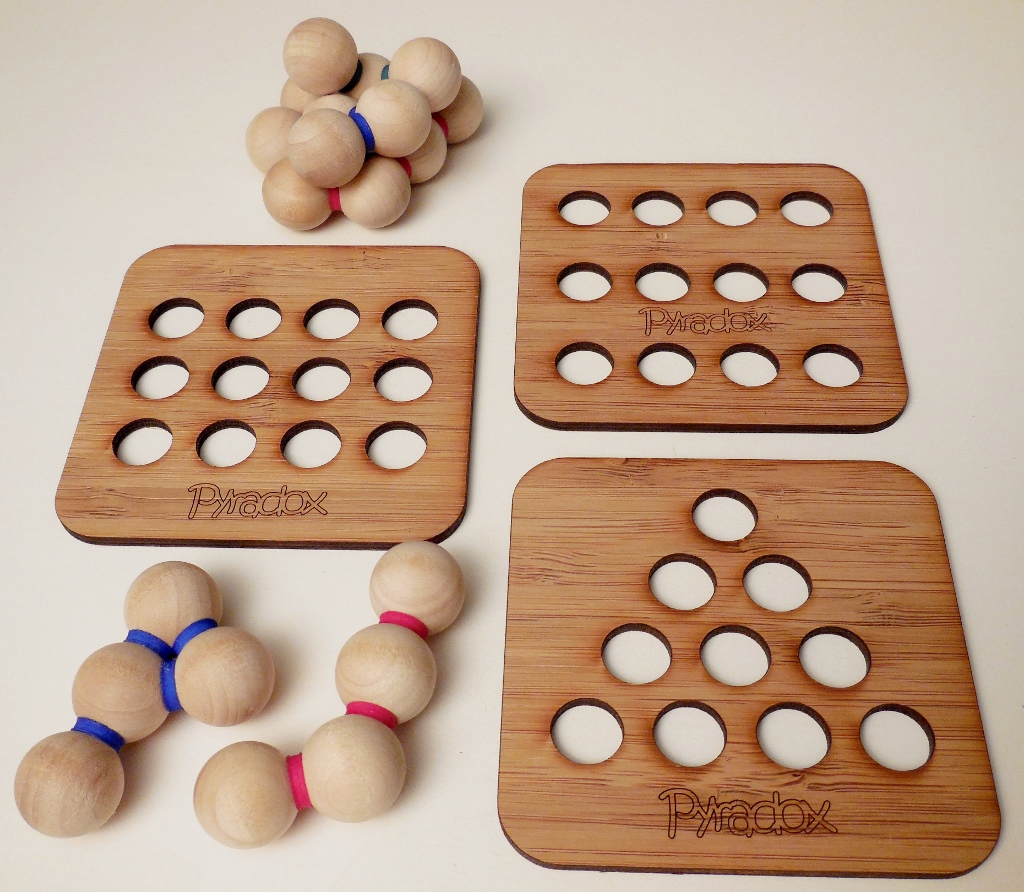
Pyradox consists of 5 plane looking pieces and 3 coasters.  The objective is to fulfill your prayers by fully filling the holey coasters with a pyramid.  Each polysphere piece consists of 4 wooden balls glued together with colored bands.  Each of the 3 colors used, red, blue, and green, identifies a unique piece shape.  On careful inspection, you will notice that one of the 3 types of shapes is different, which may be useful when solving the puzzle.  The 3 base plates are made from laser cut wood with Pyradox engraved on each and I don’t really recommend that you use them as coasters.

Each base plate provides a different pyramid building challenge.  To make it easier for you, one utilizes hexagonal close packing, one a face-centered cubic packing, and the last a warped face-centered cubic packing.  You’re welcome!

George did an amazing job discovering how the same 5 pieces can be used to construct 3 different pyramids with different packing geometries.  I found each to be fun, non-trivial, and not too difficult.  Copies are occasionally available on George’s PolyPuzzles Etsy shop.  Get one and have yourself a ball.

Wednesday, June 22, 2022

Some Puzzles Give You The Shutters – W-Windows

W-Windows by Osanori Yamamoto
Provided: Box with 2 large windows and 3 escaped pieces.  Your Mission (should you choose to accept it): Contain the pieces and shutter the box.  That’s shUtter the box, not shAtter the box, no matter how tempted you may be mid-solve.  As always, should you or any or your puzzling buds be caught shAttering the box, we will disavow any knowledge of your actions.

W-Windows is an apparent cube packing puzzle designed by Osanori Yamamoto and made by Pelikan Puzzles.  In this case the box has 2 large 2x2 windows that need to be shuttered (i.e., filled) and 2 of the 3 zig-zaggy pieces have a W theme going on.  The box is made from Apple and the pieces are made from Ovangkol.  Usually, I don’t talk about the types of woods used to make puzzles, but since I had to look up Ovangkol in my wood book (Wood! Identifying and Using Hundreds of Woods Worldwide by Eric Meier from the online The Wood Database), it’s worth mentioning that it’s another name for Shedua.  However, Ovangkol is the title for the wood description and Shedua is only mentioned in the comments.  Apparently Ovangkol is used by guitar makers who have better lobbyists than puzzle craftsmen.

After having done many of these types of puzzles and looking at the pieces for W-Windows, I expected:

  • All pieces will be used to fill the windows.
  • The W pieces will be added with some variation of an insert-shift-insert movement.  Sorry to state the obvious
  • One of the Ws has a 2x2 face, which obviously fills one of the box windows.  It’s so obvious that it can’t possibly be part of the solution.  Or could it?
  • The tetracube piece will be in the center somewhere moving around to allow the W pieces to slowly emerge from the box.
  • Each W piece will be associated with its own window.
  • The tetracube piece will have the highest move count.

I freely share these expectations with you because they are of no help whatsoever when solving the puzzle.

When I first sat down with the puzzle, I took the approach of looking for an assembly and then determining whether it could be placed in the box.  I learned 2 important things from this approach: 1) There are too many assemblies, and 2) There are a lot of ways that the pieces cannot be oriented within the box.  It’s definitely worth the time to determine how the pieces can and can’t be oriented within the box so that you can quickly recognize a possible assembly from an impossible one.

When looking for the solution, I try to find an assembly that looks like it has a few good moves.  These types of puzzles usually don’t have deep false paths, and once you find something that looks interesting, it’s frequently the solution, which was the case with W-Windows for me.

It may be the eternal optimist in me, perhaps the stubbornness, or more likely the short-mindedness, but I looked at the 2 big windows of the box and the 3 measly pieces and thought that this would be a quick score.  However, those simple pieces kept me entertained for about an hour and I did enjoy the solution once I found it.  You really can’t go wrong with these apparent cube packing puzzles from Osanori Yamamoto.  Thankfully, Osanori creates new ones faster than I can acquire and solve them.

Wednesday, June 8, 2022

Puzzle Philosophy - Yin Yang

Yin Yang by Volker Latussek
I like puzzles but they aggravate me.  When I’m working on a puzzle, I can’t wait to find the solution.  When I find the solution, I’m disappointed that it’s over.  I expected all these reoccurring conflicting emotions to surface when I pulled (pushed?) Yin Yang out to work on.

Yin Yang was developed by Volker Latussek and made by Pelikan Puzzles.  The box was made using Cherry and has a Maple (Yang) top to contrast nicely with the 6 Wenge (Yin) pieces.  When all the pieces are packed in the box, you end up with a nice digitized taijitu symbol.

Upon inspection, 4 of the Yin pieces are symmetric and the other 2 are not.  These asymmetric pieces are the key Yin and Yang pieces.  I know that I stated that the Wenge pieces were the Yin to the box’s Yang, but even when you separate them, you still have both in each.  Yeah, it doesn’t make a lot of sense, so let’s just agree to call it a principle and keep building on it.   Now that we have our key Yin Yang Yin pieces, as long as they aren't symmetrically situated within the assembly, these mystical keys can be used to affect a transformation between Yin and Yang assemblies.  You’ll also notice that extra effort went into highlighting that each piece was constructed by combining a 2x3 block with a 1x2 block.  I suppose one of those would be the Yin and the other the Yang requiring the key pieces to be formally referred to as the Yin Yang Yin Yang Yin pieces.

Yin and Yang Pieces
Yin and Yang
Since the Yang box encompasses a 4x4x3 space, the objective is to 1) Find a way to make a 4x4x3 shape with the Yin pieces and 2) discover a method for jamming those Yins into the Yang.  And the answers to all your questions are Yes – Are rotations allowed/required, Are there uncrammable assemblies, If I Yin instead of Yang will the pieces get stuck?

I’m embarrassed to admit it took longer than expected to find a 4x4x3 assembly.  Of course once I found it, it had to be the required assembly and I was never going to let it go.  I could see how the first 3 pieces would come out and only had to figure out how to release the remaining 3.  Surely, taking out (Yang?) / putting in (Yin?) 3 pieces with all that space couldn’t be that hard (With all my experience with 3D apparent packing cubes, it’s a wonder I can still think that).  Needless to say, I spent a considerable amount of time experimenting with some amazing cramming techniques with those obstinate pieces until I remembered the principle of the whole thing and immediately solved it.