Pages

Showing posts with label Andrew Crowell. Show all posts

Wednesday, July 15, 2026

Windows 2

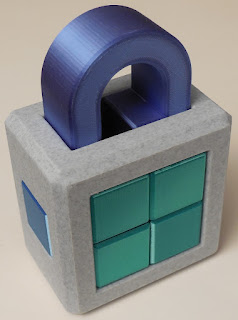
Windows 2 by Andrew Crowell
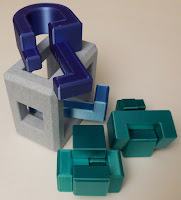
Windows 2 is a 5x5x5 Turning Interlocking Cube (TIC) designed by Andrew Crowell.  This bicolor puzzle consists of 6 pieces that form a white shell around a blue 3x3x3 apparent cube in the center.  Each side of the white exterior has 4 windows that allow you see the blue core.

When I pulled Windows 2 out to work on it, I only meant to sit down with it for a couple of minutes to figure out where the pieces went.  However, I was having such a good time that I ended up solving it before getting up.  Rather a bittersweet finish since this was the last 5x5x5 TIC in my backlog.  Luckily for me, I think I still have some 4x4x4 TICs that got pushed further back into the back of the backlog.

Initially, Windows 2 reminded my of Templars Cross (A Spirited Journey – Templars Cross) with the corners still intact.  However, I found it quite a bit easier to solve.  The last 2 pieces weren’t nearly as difficult to get in place and pieces just seemed a bit more accessible for manipulating.  If you are planning on doing both (recommended), I’d suggest starting with Windows 2 as the warm-up.

If you want to print your own copy of Windows 2, the model files are available on ARC Puzzles as part of the second volume of 5x5x5 TICs.

Wednesday, July 1, 2026

HolopTIC

HolopTIC by Andrew Crowell
HolopTIC is a 5x5x5 Turning Interlocking Cube (TIC) puzzle designed by Andrew Crowell.  As with HoleyTIC and HolisTIC (Getting Everything Back Together – HolisTIC, HolopTIC has a hole in the middle of each side of the puzzle that runs through the cube.

This one was a lot of fun with some higher order rotational moves.  However, you need to make sure that you don’t cheat on the rotations.  It is possible to make some questionable rotational moves that bypass a sequence of other moves if you’re not careful.

As usual, the more pieces you put together, the more effort is required to add the next piece.  Until you end up scratching your head with one last piece to go.  One piece in particular required a lot of attention.  It didn’t play too nicely with the others and seemed like it would be better to add sooner than later.  Figuring out when and how to add it was the major challenge.

Fairly early on, I singled out a piece that could possibly be added last with a quick rotation but decided that the rotation would be blocked.  However, preliminary tests indicated that the rotation would work just fine.  When I had all the other pieces in place and just needed to add that last piece I verified that the tests were indeed preliminary and not conclusive.  Of course, the piece didn’t just rotate in and was indeed blocked.  Yay!  More puzzling to be had.  Not much longer after that, I had it solved.

I always enjoy solving these TICs and look forward to more to come in the future.  I’m almost at the end of my 5x5x5 TIC backlog.

Wednesday, May 27, 2026

HoleyTIC

HoleyTIC by Andrew Crowell
HoleyTIC is a 6-piece 5x5x5 Turning Interlocking Cube (TIC) designed by Andrew Crowell.  It is a nice addition to the collection of 5x5x5 TICs that Andrew has created.

Determining the assembly is not difficult.  The location and orientation of each piece can be quickly determined.  The effort is getting them into position.  Especially since there are a few rotations along the way.

I divided the 6 pieces into 2 groups.  Major framing pieces and smaller finishing pieces.  The four larger pieces were allocated to the major framing pieces although 2 are bigger than the others.  Starting with the 2 largest pieces, I was pleasantly surprised that getting them together was not trivial.  And once those 2 were together, adding the 3 piece was interesting as well.  The forth piece just slides into place but you have to keep in mind that the there are 2 more pieces yet to go and it may not be as easy if those pieces have to go in first.

As expected, those last 2 small pieces are where the magic lies.  It is fairly simple to add each one individually but adding them both is a real effort.  The finishing movements required to solve HoleyTIC are as awesome as you would expect from Andrew’s TICs.

You can purchase the 3D model file for this puzzle from Andrew’s online store, ARC Puzzles.  It is bundled with model files from 5 other 5x5x5 TICs to keep you happily engaged for a while.

Wednesday, April 29, 2026

Dark and Foreboding – ApocalypTIC

ApocalipTICized
It’s dark.  It’s foreboding.  In fact, it’s downright ApocalypTIC.

Back in the dark ages when the scourge of DIY 3D printing was just getting started, Richard Gain embarked on creating Printable Interlocking Puzzles (PIP).  These were interlocking puzzles where the pieces could be printed without supports or assembly of sub-components.  At some point, his level 11 PIP #4 was used as the seed of destruction for Andrew Crowell’s phenomenal Turboencabulator that stripped the PIP restrictions and brought a new level 17 challenge to life.

ApocalypTIC is a 5x5x5 Turning Interlocking Cube (TIC) consisting of 6 pieces.  Since it was TIC’led (not pink obviously) by Andrew, we know that it is going to be challenging.  

The first challenge is to find the assembly.  This is not as easy as most TICs since it lacks a large frame piece to use as a starting point.  In fact, each piece occupies no more than 3 layers with most of them only occupying 2.

Although some piece relationships seem obvious, there also seems to be many ways to create sub-assemblies.  And manipulating those sub-assemblies is a bit fiddly until you manage to get enough pieces to hold each other accountable.
ApocalipTIC by Richard Gain & Andrew Crowell

At some point in the process, an assembly materialized from attempts at interweaving the pieces.  Swapping pieces in and out converged on a nicely morphing assembly of 4 pieces.  All that was needed was to determine how to get the, hopefully last 2 pieces, inserted.

I spent a lot of time on those last 2 pieces.  It got to the point where I could add either of them but not both at the same time.  After a lot of back and forth, I finally managed to confirm that these were indeed the final 2 pieces to go in and everything came together into a cube.

For a TIC, there are not a lot of rotations but the movements are well done and make a nice challenge.

Wednesday, April 15, 2026

3-Pronged Puzzling Approach – TritanIC Series (1-6)

TritanIC Puzzle Series by Andrew Crowell

A short while ago, just over 5 years, I reviewed a set of 3-piece 4x4x4 Turning Interlocking Cubes (TICs) designed by Andrew Crowell (Puzzle Candy - ThreeTIC, TriadTIC, TripleTIC, NeuroTIC, TriumviraTIC).  These TICs provided quick enjoyable solves to brighten the day.  Recently, a kind soul on the Mechanical Puzzle Discord (MPD) passed on another set of Andrew’s 3-piece TICs that I was more than happy to accept, but this time a 5x5x5 format.

The 6 TritanIC puzzles were designed by Andrew Crowell and like the prior 3-piece TICs, they provide a quick shot of TIC adrenaline to help get through the day.  I managed to hold myself back and do 1 a day over 6 days instead of binging them all in one sitting.
  

TritanIC
TritanIC


TritanIC, which I assume is the first of the series since it lacks a posterior numerical designator, is a nice start to ease you into the series.  One piece has more volume than the other 2 proclaiming itself as the base for adding the other 2 pieces.  The solution requires 1 straight forward rotation.  At least one other nice rotation is possible but not required and it made me wonder if it would be possible to alter the design to require it. 


TritanIC 2
TritanIC 2


I found TritanIC 2 to be twice as hard and then some as TritanIC.  I took this as a good sign that we were on a good trajectory.  TritanIC 2 has everything you would want in a 3-piece TIC where pieces have to added in orientations far from where they need to end up.  Determining how to simply put the 2 largest pieces together is not a gimme and takes some thought.  And trying to add the smallest piece to the mix is a challenge.


TritanIC 3

TritanIC 3


TritanIC 3 is a nice follow-up to TritanIC 2.  There are some nice rotations that have to be navigated to get the pieces in place before they collapse into a cube.  And you are almost guaranteed to have to back up and rethink the ordering of the pieces.


TritanIC 4

TritanIC 4


This is where the trajectory falls apart.  I found this one to be extremely easier.  Less than 2 minutes easy.  If you acquire the series, you may want to start with this one.  The most difficult part is getting the first 2 pieces together, which isn’t that difficult.  The third piece just flops in place before it it closed.  This one didn’t stand up compared to the others in the series.


TritanIC 5

TritanIC 5


TritanIC 5 gets things back on track.  In fact, it reminded me a lot of TritanIC 3 in terms of approach, rotations, and how the pieces go together.  It’s certainly it’s own puzzle, but has the same overall feel as TritanIC 3.


TritanIC 6

TritanIC 6


I found TritanIC 6 to be a tricky bugger.  Multiple rotations are required to get the pieces into position before they can start moving into place.  In fact, a few days later, it was non-trivial to determine how the pieces came apart.  A nice way to end the series!


Expanded But Not disassembled


Thursday, February 26, 2026

A Spirited Journey – Templars Cross

Templars Cross by Andrew Crowell
Templars Cross is as easy as Six Face (Little Nightmares – Six Face), the last Andrew Crowell Turning Interlocking Cube (TIC) that I did.  In other words, I found it difficult.  Six Face had a piece that just gave me problems.  Templars Cross gave me twins to deal with.  Beware the terrible twos(ome).  But let’s start at the beginning.

Templars Cross is a 5x5x5 TIC designed by Andrew Crowell.  The red outer shell encases a 3x3x3 white apparent cube.  Each side of the outer shell has 8 missing voxels basically giving you 6 red crosses on a white background.  Of the 6 pieces that comprise Templars Cross, 2 are mostly red and 4 are mostly white.

Creating the red outer shell is not difficult but adding the white pieces becomes progressively harder.  The first piece is a gimme with a gotcha.  However, the gotcha will be short-lived if you stumble across it.  That leaves 3 little pieces to go.  2 are all white and 1 has a single red cube.  And that single red cube will be your friend once you solve it.

You need to determine how to place the 3 white pieces to make a cube with the white pieces already in the frame.  And do it such that the single empty voxel is cached behind the red frame making the cube appear solid.  And do it so that the frame pieces can be put together.  Did I mention that those twins have to be rotated several times while all this is going on?

Templars Cross Pieces
The twins are mirror images of each other and are the A and B Soma pieces.  One end of the A piece is red so that has to plug the missing spot in the frame.  Easy, right?  Not so much.  And with all those rotations going on, it gives you an extra opportunity to get the wrong end of the A piece sticking out.

It’s an effort to determine how the white pieces need to be oriented in the cube.  It’s a bigger effort to determine how the pieces need be oriented to get the cube apart.  It’s an even bigger effort to determine how to perform the rotations to go between the 2 orientations.  This is the part that I really struggled on.

After a couple of sessions with Templars Cross, I was beginning to understand the symbolic tie to martyrdom and sacrifice.  I finally decided to throw a Hail Mary and put the pieces in what I assumed was the starting configuration and closed it up.  The only thing to do now was to rotate the pieces until it was solved, taken back apart, or stuck.

Once the frame is closed and locked (yes, one of the pieces acts as a lock), the 2 halves of the frame only shift 1 voxel in either of 2 directions but not both.  It turns out that both are needed in the solution.  I was happy to discover that I had indeed correctly figured out the starting configuration and was able to perform the required rotations to achieve the solved state.  And I find it highly repeatable knowing how Rudolph needs to be oriented.

Wednesday, February 4, 2026

Little Nightmares – Six Face

Six Face by Andrew Crowell
It seems that I’ve been on a Turning Interlocking Cube (TIC) hiatus.  Not sure how that happened, but I’m glad to have recently acquired some new Andrew Crowell gems in the 5x5x5 format.  The first one that I decided to tackle was Six Face.  Not Six Faces, Sixth Face, or Six’s Face but Six Face.  I could only assume that it would be a significant challenge and reveal itself as a little nightmare.  Needless to say, it took me longer than expected to solve.

Six Face was designed by Andrew Crowell and my version is 3D printed.  The puzzle is not a complete 5x5x5 cube but looks like a 3x3x3 cube with each face extended outward.  One of these faces is debossed with the name of the puzzle.  The face was carefully chosen so that the name was on a single piece to avoid providing any additional placement clues.  In total, there are 6 pieces that have to be assembled into the final shape.  It only takes 28 moves and there are a couple of rotations along the way.

I took Six Face and several other puzzles with me on vacation to PA, which is ironic since they were sent from PA by kind gentleman looking to spread the frustration.  And by frustration, I mean joy of course.  As always, I overestimated the number of puzzles that I would need.  I started with Six Face and almost ended there as well.  At least I was able to bring it home solved.  YES it was me that solved it!  I’m disappointed that you would even think otherwise.

Solving Six Face took me several sessions.  Right out of the bag, you need to spend 1 of your rotations to get the first 2 pieces together.  Or are they not the first 2 pieces?  Only time will tell.

With the 3 biggest pieces, you can construct most of the visible shape leaving you with the 3 smaller pieces that need to fill the gaps.  Of course, the order of entering those pieces and movements required are what make the puzzle challenging.  Two of the smaller pieces are dancing partners and work nicely to build out the solution path.  But it’s that last piece that is the crux of the solve.  For whatever reason, I had a huge blind spot concerning the where, when, and how of this piece.  It could obviously exist in 2 different orientations, so there were twice as many avenues to explore.  Adding it earlier would provide more room for it to navigate but of course would reduce the mobility of the other pieces.  And just how could that crux piece be added and manipulated into position.

Six Face Pieces
I’m sure it will come as no surprise that a lot of steps were repeated looking for a new avenue to present itself.  With all this experimentation, it became apparent that the final orientation of the crux piece would be different from the orientation that it would enter the framework with regardless of which of the 2 possible orientations was the correct one.  You would think that knowing this, it would be easy to find an orientation where it could be inserted within the frame.  However, I found this a difficult challenge.

Eventually, I found a way to add the crux piece and rotate it into place.  So simple!  How could I have missed it?  All that was left was to determine how to add the dancing partners with it.  Not easy.  Nope.  Not happening.  And it didn’t happen, leaving me to wonder if it was just difficult or if I was barking up the wrong orientation.  At this point I had to split my time between working this approach as well as trying to find an approach for the other crux piece orientation.

Eventually 2, I found a way to add the crux piece in the other orientation and rotate it into place.  So simple!  How could I have missed it?  All that was left was to determine how to add the dancing partners with it.  At least this time, I was able to get everything in place and finally solve Six Face.

Fast forward several months to now when I want to blog about it and take it apart.  No surprises.  The crux piece volunteers to rotate and comes out nicely as expected.  Mission completed!  Except I can’t get it back together!  Try as I might, I just can’t find the exact insertion trajectory.  Unbelievable!  (You’d think by now that I would find this believable).  I spent at least another hour if not 2 getting it back together.  Not only that, I had to check both crux piece orientations since I didn’t pay attention to which one it was when taking it apart.  I’m assuming/hoping that if I take it apart again several months from now, it will be smooth sailing but at this point, I wouldn’t be at all surprised if it were a rough ride.

If you're interested in acquiring any of Andrew's puzzles, you can visit his online store ARC Puzzles.

Wednesday, August 6, 2025

A Solid Challenge? – NotchedTIC

NotchedTIC by Andrew Crowell
ARC TICs are extremely cool puzzles and most of the ones that I have solved have been 4x4x4 cubes.  One notable exception being MagellanTIC (Space, The Final Frontier - MagellanTIC), which is a 5x5x5 apparent cube and an awesome experience.  And now we have NotchedTIC, which is a non-apparent cube.

There’s just something so satisfying about solving a Turning Interlocking Cube (TIC).  However, it’s been a while since I’ve tackled a TIC by Andrew Crowell, aka ARC Puzzles {https://arcpuzzles.com}.  In 2020, I reviewed a different TIC by Andrew each month, with December’s being CagedTIC 1 (Ending With a Beginning - CagedTIC 1).  That post also had the links to the other 11 TIC posts for that year.  Although there were more ARC TIC posts, they weren’t as frequent and eventually trailed off.  How did that happen?  Well sometimes I get easily distracted. SQUIRREL!!!  Squirrel? Squirrel squirrel squirrelsquirrelsquirrel…

NotchedTIC is a 3D printed 6-piece 5x5x5 TIC designed by Andrew Crowell.  It gets it’s name from each edge having a missing voxel in the center.  And the puzzle arrived disassembled, which is my preference for attacking most burr puzzles.

NotchedTIC Pieces
The pieces to this puzzle fell into place fairly quickly.  Piece placement was obvious and pieces were able to be added 1 at a time with backtracking where needed to add a new piece.  Assembling the puzzle takes 28 moves with about a dozen of them required to add the last piece.  Along the way, 2 rotations are required but you don’t need to worry as they are not complex and obvious when needed.  In fact when taking the puzzle apart, the rotations will execute by themselves as pieces scramble to evacuate the TIC infested region.

I would classify NotchedTIC as more fun than challenging for experienced puzzlers.

Although I bought my copy second hand, you can buy the 3D Printable STL files for NotchedTIC and 5 other 5x5x5 TICs as part of a 6-puzzle set from Andrew’s site, ARC Puzzles.

Wednesday, July 24, 2024

Don’t Sleep On This One – InsomniAC1

InsomiAC1
Wow!  Just Wow!  What a ball buster!

Given the way the title is presented and the fact that this puzzle is not a lock, you figure there is a good chance that this puzzle was designed by Andrew Crowell.  And you would be right.  And being designed by Andrew Crowell, you know it’s going to be great.

InsomniAC1 was Yacine Boucef’s exchange puzzle for IPP41.  It is an apparent cube (or squat cube in this case) packing puzzle where all the openings need to be filled.  The woods are not provided on the packaging but I would guess that the pieces are made with Wenge, Padauk, and Mahogany with a Maple box.

I found the assembly early on but that was the easy part.  I’ve learned with these types of puzzles that if it looks like a good assembly and has a couple of good moves, it’s probably the one you are looking for.  All you need to do now is discover the sneaky moves that are required to complete the insertion sequence.

This one was tough.  Not only was the solution a challenge to find but the required rotations, were not simple to perform.  This was exacerbated by the diminutive size of the puzzle.  It’s not easy to manipulate the pieces through the opening and of course the pieces conspire against you by getting in each other’s way.  And no, this is not one of those puzzles where when it’s solved, the first piece drops right out.  Far from it.

Usually, I store these puzzles in the solved state so they take less room but for this one, I’m a little concerned that I may forget how to get the pieces out.  I may store this one in an alternate configuration.

I recommend getting one if it becomes available.   And if you have the opportunity to acquire a larger one – go for it!

Wednesday, February 16, 2022

X-tra Protection – T Lock

T Lock by Andrew Crowell
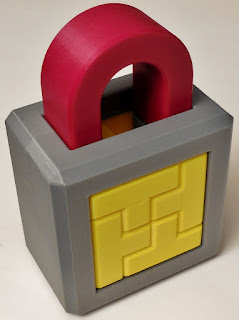
Last week’s blog got me thinking about protection so I thought it might be time to circle back and cover T Lock, the second of Andrew Crowell’s 3D printed burr locks that I recently acquired.  It certainly has secured a well-deserved spot in my collection of enjoyable puzzles.

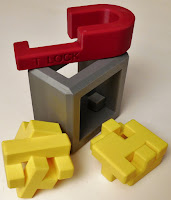
Like Side Lock (www.zenpuzzler.com/2022/01/put-it-to-side-lock.html), T lock has a main frame (for all you old programmers out there), a shackle, and 4 T pieces that are packed in the frame.  The pieces are nicely 3D printed in gray, red, and yellow.  Since it doesn’t have the fifth piece running side-to-side like Side Lock, I expected it to be slightly easier.  Of course, it turned out to be slightly harder.  T Lock requires 15 moves to remove the first piece compared to 19 moves for Side Lock, but T Lock requires a rotation, which gives it that boost in difficulty.  Recall that puzzle difficulty = cube root of total voxels * pieces * highest piece moves * log(10 + rotations * 100)  / 100.  {Factors to compensate for things like n-ary inflation have been dropped for simplicity.   Compensating factors for piece surface area have also been removed since they are a pain to compute.  However, for designers that needlessly increase voxel resolution, these factors should be added back in.}

I’d like to describe how easy the original disassembly was, but it was so long ago I can’t remember.  This became all too obvious as I worked to get it back together.  In fact, I forgot that a rotation was required, which really is the crux move of this puzzle.  Needless to say, accomplishing the solve was a challenge.

T Lock Pieces
The frame has 3 impeding cubies attached inside to help you figure out where you can, or more appropriately, where you can’t, put pieces.  These cubies only permit the shackle to be inserted in one orientation, so you can also add the shackle to places where pieces can’t go.  With some work, you can then determine where the 4 T pieces go, although I admit to doubting this configuration many times and re-examining it.  Trying to get those 4 pieces in the frame took some effort.  Once I finally figured out which 2 pieces needed to go in first, I had a devil of a time trying to get them situated in the frame.  

Typical Crowell puzzle scenario – struggling to get 2 small pieces in a big open frame.  Been there many times.  This is where I spent most of the time in the assembly until I finally enjoyed the Aha moment that resulted in not just the first 2 pieces in the frame, but all 4.  

T Lock is difficult and very satisfying as an assembly puzzle.  Having done it several times now, although not as difficult as an assembly puzzle, attacking it as a disassembly puzzle is interesting as well.  You can get copies of T Lock on Andrew’s online store, ARC Puzzles.

Wednesday, February 2, 2022

Wonderizing Puzzles – Benno’s TIC 2.0

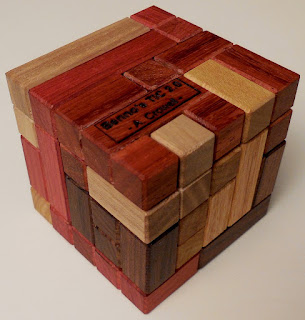
Benno's TIC 2.0 by Benno de Grote and Andrew Crowell
As I was enjoying perusing through the myriad of beautiful puzzle photos on the Mechanical Puzzles Discord (MPD) server, I saw a particularly attractive puzzle made from several exotic woods.  Paduak, Redheart, Canarywood, Yellowheart, Maple, and Walnut comprised this intriguing puzzle made by George Syriaque.  The story behind the puzzle was as interesting as the puzzle itself.

George was fascinated by a puzzle designed by Benno de Grote called Favorite.  It is level 7 puzzle and George was interested in knowing if the complexity could be increased.  To scratch that itch, he shipped the design off to Andrew Crowell to pass it through his Magical Puzzle Wonderizer.  For those of you unfamiliar with the Andrew’s Wonderizer, it takes a plain puzzle design as input, breaks it down to its core puzzle DNA, injects complexity steroids, and reconstitutes its components into its new uber form.  So what would happen if you put in a design that was already great to begin with?  Would it strip out the elegance and produce a quotidian block of wood?  As it turns out, the Wonderizer took the level 7 puzzle and produced a level 16 puzzle with some added rotations sprinkled in, which was summarily named Benno's TIC 2.0.

For a long time now, George has been posting enticing photos of the puzzles that he has been making, whetting everyone’s appetite for more wooden puzzles.   Certainly not immune to that allure, as I gazed upon the photos of Benno’s TIC 2.0, I said to myself, “I’d love to give that puzzle a try”.  And then I moved on since they were not being produced.

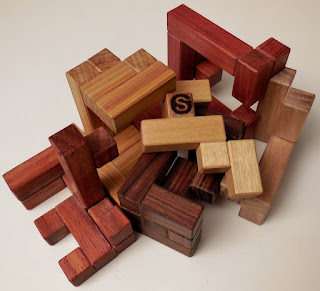
Benno's TIC 2.0 Pieces
Several weeks later, I received a package.  A package from my good friend George.  A package that contained a single cubic box.  The kind of nondesript white foldup box that puzzles sometimes come in.  Inside this box was, you guessed it – some foam wrapping!  Yes!!! Foam wrapping!   That's such a good sign!  And sure enough, protected by that foam wrapping was Benno’s TIC 2.0 that I saw on the MPD.  WOW!!!

Instead of drooling over pictures on the MPD, I now had one in hand.  TICs are my thing and…I can’t find the first move.  That first piece fits snuggly in the cube and took a couple of minutes to locate.  After a couple more moves, things start to open up and you may find that you are going in circles.   However, once you break out of that circle, pieces start emerging from the cube.

The dance required to separate the last 3 pieces was particularly nice.  Looks like it would be easy, feels like it’s impossible, and is greatly appreciated when you finally successfully traverse the correct path.  Need I say that the path is a bit twisted.

Reassembling the puzzle right after disassembly while all the moves are fresh in mind is easy.  It is much more interesting to leave it unassembled and tackle discovering the moves in reverse.

Since I don’t have a copy of the original Favorite design by Benno, I can’t comment on the differences between the original and the wonderized version.  I can say that the Benno’s TIC 2.0 is a great design and fun to solve.  Thank you George!  Thank you Andrew!  Thank you Benno!

Wednesday, January 19, 2022

Put It To The - Side Lock

Side Lock by Andrew Crowell
It had been awhile since I’ve played with an Andrew Crowell puzzle, so I headed over to the arcWoodPuzzles shop on Etsy to see what’s new.  Andrew is a prolific puzzle designer and there’s always something new.  Amongst the fine selection of puzzles, I discovered several intriguing burr lock puzzles and decided to give them a try.  The first of the two that I selected was Side Lock.

The first thing that surprised me when the puzzles arrived was how big they were.  They were twice as big as I was expecting, providing a nice heft for 3D printed puzzles.  The puzzle consists of the frame and 6 other pieces: 4 short burr pieces, the longer burr side piece, and the shackle.  As expected from puzzles 3D printed by Andrew, the fit and movement of pieces is excellent.  The puzzle is also quite attractive, made using a marble-like filament for the frame and shiny blue, green, and purple filament for the pieces.

Since Side Lock arrived assembled and my preference is to attack these types of puzzles as assembly challenges, I quickly disassembled it and planned to leave the pieces untouched for a couple days while any vestiges of piece movement memory quickly decayed.  Quite honestly, at this point in my life, anything over 5 minutes is overkill.  A couple of months later, I found the pieces and attempted the reassembly.

Side Lock Pieces
With an empty frame and 6 pieces, I began tackling the reconstruction of Side Lock.  There is a feature within the frame that matches one of the pieces thus revealing the location of the first piece.  With the location of the first piece known, the location of the next piece becomes obvious.  At this point, I’m thinking, “This is easy, only four more pieces to go!”.  However, this was the end of Easy Street forcing me to kickstart that old clunker of gray matter.  Where once the old brain could breeze through these problems, I can now feel it wheeze through the process.  Eventually, the pieces found themselves in the shape of a lock once again.

I really like these lock shaped burrs and at 19 moves to remove the first piece, it’s a nice little challenge.  The one thing that I would like to see changed with the puzzle is to have the name debossed on the outside instead of on the shackle hidden in the frame.  I like to be able to reference the name without having to disassemble the puzzle.  However, I realize that this is my personal opinion and that there are people that don’t care to have the outside of their puzzles defaced with any type of lettering.

Wednesday, January 13, 2021

Per Aspera Ad Astra - StarTIC 1-4

StarTICs 1-4 by Andrew Crowell

Although it has taken several decades, I finally found something tangible that explains my college motto: Per Aspera Ad Astra - through adversity to the stars.  This something comes from the fiendish mind of that Turning Interlocking Cube (TIC) master Andrew Crowell, who knows that the only thing better than a puzzle is a cluster of puzzles.  With that in mind, he embarked on creating a series of StarTICs.  Of course, he attempted to pack as much adversity as possible within each to entertain us along the journey.

StarTIC 2 PIeces
The StarTIC cluster consists of 4 heavenly bodies.  Each has its name debossed on the outside and Andrew’s name debossed on the inside.  Each has its position in the series at the end of the name except for the first, the original StarTIC.

The StarTICs occupy a 5x5x5 cubic dissection space.  Each consists of a gray shell surrounding an inner 3x3x3 core with a unique color for that StarTIC.  Although the core appears solid, each is comprised of several pieces.  The objective is to have the core go critical and eject its mass from the center of the shell.  Bits of the shell may remain stuck to the pieces while some bits of the core may be left behind on the empty shell.

StarTIC

StarTIC  by Andrew Crowell
Starting the cluster is StarTIC with its red hot core.  When assembling StarTIC, it’s easy to determine where the pieces go within the shell.  The largest piece contains a large section of the shell and can only go in one place.   Once that piece is in place, the remaining 4 pieces can be divided into 2 that add 2 cubes to the shell and 2 that add 1 cube to the shell.

After careful examination, you can determine that 3 of the 4 shell vacancies look like they can be satisfied by 2 of the core pieces.  The fourth can only be completed by one of the core pieces but it can go in that spot in 2 different ways.  However, it is immediately obvious that only one of them makes sense.  Once that piece is in place, it is obvious where the other 3 core pieces have to go.  The only thing left is to determine the order and movements required to get them in place.  Of course, some rotations will be required, but they are minimal.  

My favorite rotation involves the “T” piece that gets translated halfway through the rotation.  I designed a puzzle around this type of move about a decade ago called Interrupted.  It was the only thing that this puzzle had to offer.  One of the reasons that I like Andrew’s puzzles so much is that they have so much more to offer than just a single interesting move.


StarTIC 2

StarTIC 2  by Andrew Crowell
StarTIC 2 has a cold dark blue core.  Unlike StarTIC, the StarTIC 2 frame is only missing 3 small pieces, which can be found connected to 3 of the 5 pieces that comprise the core.

If you are tackling this as a disassembly challenge, you appear to be presented with a catch 22 situation.  It looks like a 2 block chunk of the shell connected to one of the core pieces needs to be removed to get the core pieces out.  However, it also looks like this piece can only be pushed into the core and not pulled out.  It appears that the main challenge is to figure out how to remove this plug from such an obvious exit portal.  Or is it?  You’ll have to see for yourself.

As an assembly challenge, you need to discover the very specific order of adding and rotating the pieces to the frame including plugging that 2 block gap in the shell.  Of course, when adding the first few pieces, a lot of movement and rotations are possible.  Even fully assembled, quite a bit of movement is allowed.


StarTIC 3

StarTIC 3  by Andrew Crowell
StarTIC 3 sports a cheery orange core, which is comprised of only 4 pieces.  One of these pieces also has a significant portion of the shell attached.  You would think that this puzzle would be easy with the shell separating into such large chunks.  You wouldn’t be wrong either.  I found StartTIC 3 to be the easiest of the StarTICs in the cluster.

With either the disassembly or assembly, it is not difficult to figure out what is going on within this StarTIC.  Rotations and movements are straightforward and shouldn’t prove to be difficult for most users.  If find yourself intimidated by this cluster, start with StarTIC 3.


StarTIC 4

StarTIC 4  by Andrew Crowell
The fourth StarTIC has a cool green core.  As with the other StarTICs, for the disassembly, you will be tempted to remove the piece with the largest piece of the shell attached.  Although there doesn’t appear to be much holding it in place, it refuses to come out.  It takes a lot of experimentation to determine the convoluted dance required of the core pieces, including numerous rotations, to release the first piece.  Once you have accomplished that, it’s all over. The other pieces can simply be plucked out one by one.  If you yank them out quickly without paying too much attention, you can also enjoy the following assembly process.

The assembly process is a lot of fun with StarTIC 4.  All the core pieces have a piece of the shell attached and aren’t difficult to place.  However, finding the right order to add, move, and rotate them will be challenging, especially considering the lengthy sequence of movements and rotations to get all the core pieces in place once the last one has been added to the shell.  


The StarTIC cluster is a worthy addition to Andrew’s TICs.  Not a single loser in the bunch -  they’re all stars!  

Per Aspera Ad Astra


Wednesday, December 30, 2020

Ending With a Beginning - CagedTIC 1

CagedTIC 1 by Andrew Crowell
This is the 12th and final post of the monthly Andrew Crowell Rotations and Obstructions Series - Turning Interlocking Cubes (ACROSTIC).  A year ago, I decided to do a post every month during 2020 of one of Andrew’s TIC puzzles after buying a large batch of them.  Of course, I acquired many more of them during the year and the later posts are of more recent acquisitions.  You can tell from the newer acquisitions that Andrew has the 3D printing process figured out and the quality of his puzzles has become excellent.  

CagedTIC 1 is a perfect puzzle to end this series on.  It looks great, it’s difficult, and the “1” seems to indicate that there will be more to follow!  Did I mention that it’s difficult?  Even though I almost always recommend that you receive these puzzles disassembled, you can get this one assembled if you want.  It’s a challenge to even get all the pieces out of the frame.

So let’s get into it.  The puzzle fits within a 5x5x5 cubic area.  The simple frame comprises all of the cubes edges and is made from a marble PLA with the name of the puzzle debossed on one edge.  The 7 pieces that get packed into the frame are made from a light blue PLA and Andrew’s name is debossed on one of them.  The packed pieces leave the center of each of the 6 cubic faces unoccupied to make a pleasant design.  The pieces fall into 3 categories.  

Pieces 1-3

The first 3 are filler pieces that serve as spackle to construct that attractive final shape and each can simply be pulled from the puzzle in a single move.  However, the filler pieces do serve an important function for the puzzler.  They help identify how the other pieces need to be oriented within the frame.

Piece 4

The fourth piece is not difficult to remove but can’t be pulled out in a single move.  It also requires a rotation to extract it from the cage.  

Pieces 5-7

The final 3 pieces are the real challenge.  With only 3 pieces left to remove, you would think that it would be easy to just shake them out.  However it is far from easy and, needless to say, requires several rotations to accomplish.  It’s not even easy to determine which of those pieces need to come out first.  I wasn’t certain which one it was until I managed to free it.  Removing the remaining 2 pieces is not that difficult.

CagedTIC 1 Pieces
I had originally taken the puzzle apart when I first received it and didn’t tackle the reassembly until months later, leaving me with a good challenge.  Of course, I easily got 6 pieces in without one of the difficult trio and them spent quite a bit of time trying to get the trio established within the frame.  Of course, I had to take it apart again for the blog photos and struggled again to get the trio back out.  I know how those 3 pieces have to go within the frame but it’s a struggle every time.  Brilliant puzzle!

Although this is the last of the monthly series of TICs from Andrew Crowell, never fear.  I’m a fan of Andrew’s puzzles and I’ll certainly be including more of them in next year’s posts.  I’d like to thank Andrew for his awesome and prolific output of TICs and other puzzles over the last couple of years and look forward to seeing what the future brings.  I hope these TIC posts have inspired some of you to try and enjoy Andrew’s puzzles.  He usually has some available on his Etsy shop, arcWoodPuzzles, if you are looking for them.

You can find the prior posts of the series here:

January: Puzzling DNA - GeneTIC

February: TIC, TIC, TIC - PackTIC II

March: Green Beer ‘ill Cure What Ails Ya - BioTIC

April: The Proper Way to Solve a Puzzle - PedanTIC

May: Will This One Really Be Better Than The Others? - SkepTIC

June: Space, The Final Frontier - MagellanTIC

July: Hanging in Suspense - PackTIC V

August: Fantastic 20+ Move TIC with an 11 Move Non-TIC Alternate Solution - PatheTIC

September: I Had This Feeling That I Was Going To Like This Puzzle - MystTIC

October: A Self-Fulfilling Prophecy - Fantastic

November: Puzzle Candy - ThreeTIC, TriadTIC, TripleTIC, NeuroTIC, TriumviraTIC

Wednesday, December 16, 2020

Puzzle Purchasing Pandemonium – Cluster & Inelegant Box

Cluster by Andrew Crowell & Inelegant Box by Haym Hirsh

Puzzle madness has gripped the world!  A once humble community of puzzle enthusiasts has morphed into an insatiable world-wide puzzle-gobbling beast.  Reports of shopping cart thefts and shop crashing are now commonplace on puzzle messaging sites.

Puzzle demand now far outweighs the supply generated by a few key craftspersons around the world.  The entire internet can be felt sagging as puzzlers around the world refresh their screens multiple times per second in the anticipation of newly released puzzles.  Mom & Pop puzzle shops are collapsing under these loads forcing a migration to more sophisticated ecommerce website providers.

For the holiday season, Brian Menold at Wood Wonders decided to embrace this madness and held a special 24 hour “Snatch the Puzzle” event on Black Friday, 27 November 2020.  During the event, puzzles were randomly made available at deeply discounted prices as a way of saying thank you and providing some holiday fun for the puzzling community.  It consisted of puzzles from recent and future releases as well as some other goodies like puzzle stands.

However, Brian took pity on everyone.  To avoid having everyone repeatedly hit the refresh key for 24 hours (please don’t take this to mean that I don’t think there aren’t people up to such a challenge), he periodically posted clues via Facebook on 25 and 26 November 2020, providing hints at the times that he would be releasing puzzles:

  • Will you be looking for puzzles in prime time, or when you're having a piece of pumpkin pie?
  • I wonder if a label might come in handy?
  • Let's start early. Same time forward or backwards.
  • Is it a time or an airplane?
  • There may be an emergency or two tomorrow!
  • Why are those guys all sitting cross-legged on the floor on such a windy day?
  • Another time, same backwards and forwards, and upside down.
  • Police - Location (US)
  • And finally, should I repeat myself?

Who couldn’t pass up an opportunity like that!  Like everyone else around the globe, I continually mashed the refresh key at what I hoped were the release times in an attempt to grab a puzzle.  Most of the time, I managed to get a puzzle in the cart, only to have it disappear before checking out.  The event was almost over before I managed to successfully acquire a puzzle.  When my wife asked me what I bought, I sheepishly looked at her and said “I have no idea.  If you have to look at it before you buy it, it will be gone.”  Of course, all of Brian’s works are wonderful and you really can’t go wrong.  Shortly after the event, I received a box from Wood Wonders with 2 puzzles.

Cluster

Cluster by Andrew Crowell
I initially had the opportunity to solve a copy of Cluster prototype that Brian brought to RPP last year (A Decade of Puzzling - RPP 2019) and was glad to finally acquire a copy.  The version that I received was made from Cambodian Ormosia.  It has an awesome grain looking like black bolts of lightning running through the wood.  It also has an interesting distinctive scent that reminded my wife of Sandalwood.  Cluster was designed by Andrew Crowell and it should come as no surprise that rotations are required to solve this puzzle.  In fact, all the pieces require rotations.  One of the pieces makes a rotational circuit through the puzzle, which I consider the highlight of the puzzle.  The puzzle is not very difficult, but the crystal shape requires some out-of-the-box-shape thinking.

Inelegant Box

Inelegant Box by Haym Hirsh
Inelegant Box is my second acquisition from the Inelegant Puzzle series by Haym Hirsh made by Wood Wonders.  My first was Inelegant Fake (Not Your Elegant Hoffman Packing Puzzle - Inelegant Fake).  Like Fake, Box is made from 4x5x6 unit blocks that have been joined into 6 "L" shaped pieces consisting of 4 blocks each.  Since this consists of only 24 blocks, the completed cube is missing 3 blocks.  One of those blocks is the center of the cube making it hollow – aka a box.  This puzzle is not that difficult, but you do have to keep in mind that that there are missing blocks and you may have a difficult time solving this puzzle without that in mind.  The version I received from Brian was made with Canarywood and has a beautiful reddish grain to it.  It also came with a Curly Maple frame that shimmers as you tilt it.

Puzzle Stand by Brian Menold

Brian enjoyed providing this event to the puzzle community and is considering making this an annual event.  I’ve already started a finger training route in anticipation of next year’s event.  Thank you Brian for a fantastic time (12:21, 2:33,  3:14, 3:35, 4:06, 7:47,  9:11, 10:20, 11:11, AM/PM)!


Wednesday, December 9, 2020

They’re Everywhere! But This One Is Special! - ACorn

ACorn by Andrew Crowell
This time of year, there is nothing but acorns everywhere you look.  They cover the yard, they cover the sidewalk, they cover the street, and you can hear them raining down on the cars.  You have to be especially careful when you are out walking to avoid having them roll your feet out from under you.  You also learn pretty quickly to cover your head anytime there is a slight  breeze.  Even as we near the end of this year's acorn barrage, I was still happy when one particular ACorn hit my house.

This new ACorn is one of Andrew Crowell's new Apparent cube puzzles. It’s 3D printed with a light brown frame with the name debossed on the side.  Like ManiAC, which was the subject of last week's post (Apparently Another Crazy Puzzle - ManiAC Shuffle), it has 2 separate challenges.  Each challenge involves taking a set of pieces and packing them into the seemingly wide-open frame so that it appears to contain a squat 3x3x2 cube.

The first challenge uses a set of 3 marble pieces debossed with the number 1 on them.  This challenge is a warm-up and much easier than the second challenge.  The rotations required were fairly simple and didn’t require any dexterity to accomplish.  If you’re new to these types of puzzles, this is the one to start with!

On the other hand, the second challenge consisting of 4 black pieces debossed with the number 2 was a real challenge.  Although there is a rotation, this one is not about rotations.  There are only so many ways to insert the largest piece and I found myself going around and around and doing the same things over and over.  I finally gave up and started to think about the problem.  The key thought that led me to the solution was a[sigjfi[j giegr[erjoier gjerg [eji9g[e9jge[ 9rjgeg ijergad fgjldjgioe wrkj gioekr kgjdgj;ek gjrkiejg  - Sorry, nodded off and my forehead took over the typing.  Where was I?  Oh, yes - this second challenge is what makes this puzzle a must-have and the first challenge is simply an added bonus.  

ACorn is a great puzzle with both an easy and difficult challenge.  Something for everybody!

Wednesday, December 2, 2020

Apparently Another Crazy Puzzle - ManiAC Shuffle

ManiAC Shuffle by Andrew Crowell
That maniacal puzzle designer, Andrew Crowell, has been at it again.  Back in September, I reviewed Andrew’s initial foray into developing what is being referred to as apparent cube puzzles (Apparently Packing Puzzles - Corner Cube, Edge Cube, Angle Cube).  The objective of these puzzles is to pack some reluctant puzzle pieces into a box with one or more restricted openings such that the box appears completely full.  I say reluctant, because it can be difficult to cajole those pieces into their proper positions with multiple twists and turns.

Andrew’s new apparent cube puzzles come with two sets of pieces for twice the frustration.  The first one that I tried was ManiAC Shuffle.  Please note that Andrew highlighted his initials in ManiAC - or does that stand for Apparent Cube?

As with the prior apparent cubes, ManiAC shuffle is 3D printed and consists of a gray frame and a set of 4 bronze pieces debossed with the number 2 and the another set of 3 blue pieces debossed with the number 3.  Andrew had help with naming the puzzle and number 1 got lost in the shuffle.  Apparently, the honor of naming the puzzle went to the first person to solve it on the Mechanical Puzzles discord group.  The blue and bronze pieces are made with the shiny PLA and look awesome!

One good hint for solving this type of puzzle is the realization that it takes several moves to take the first piece out when it is assembled.  If you are contemplating a configuration of pieces where the last little piece just gets shoved in a hole in one move, you’re on the wrong path.  Another little hint for you is that the debossed numbers on the pieces are not visible when the puzzle is solved.  Before you all start jumping up and down crying that I’ve just ruined your solving enjoyment, Andrew placed all the numbers on inside faces of the pieces.  You didn’t really think that I would give you any kind of useful clue, did you?

I initially solved both ManiAC challenges a couple of weeks ago and then solved then again to refreshed myself on the solutions for this post.  The first time that I solved ManiAC, I started with the blue pieces that were numbered 3 and I did the same when I solved it this time.  I just assume that fewer pieces equates to easier and I always like to start with the easy one.  Well, I can tell you that after sitting around for a couple of weeks, it wasn’t any easier the second time around.  Tough little bugger for only three pieces.  One piece is 3x3x1 so it can only go in the 3x3x2 frame laying flat and there only seems to be one way that it can be inserted.  With one piece down, you would think that it would be close to being solved.  Not quite.  It took some effort to figure out how to add the other 2 pieces.  Of course, every piece has to be rotated and one of the rotations is a real dexterity challenge!

The bronze set seemed easier than the blue set, but to be honest, when you’re working on a few of these at a time, your brain gets a little warped as you work through them and you can start to see around the corners more easily.  Unlike the blue set, not all the pieces have to be rotated.  However, you will start to recognize the common theme of having to insert a piece in an orientation that does not seem possible.  It’s also amazing how many moves such a small number of pieces require to make an apparent cube in the frame.  A lot of these moves are accomplished by tilting the box in various directions to get the pieces to slide where they need to go.  Yes, you’ll look like a maniac.  Be sure to do it with your tongue hanging out!

Wednesday, November 11, 2020

Puzzle Candy - ThreeTIC, TriadTIC, TripleTIC, NeuroTIC, TriumviraTIC


Puzzle Candy
There is something nostalgic and completely satisfying about a dish full of colorful treats in an assortment of pretty colors.  Delicious!  However, as I’ve gotten older, I’ve had to replace sugar with plastic.  Thanks to Andrew Crowell’s new Turning Interlocking Cube (TIC) designs, I can continue to feed this habit.

Andrew has been developing several TIC designs that consist of only 3 pieces, which I refer to as puzzle candy.  Not a meaty solve that you can sink your teeth into, but something refreshing that you can experience in short burst of time.  It may only take you a couple of minutes, but will surely leave you with a smile.  And the best part, there are no filler pieces.  All 3 pieces are integrally involved in the solution.  These 3-piece wonders also don’t have externally visible voids.

With only 3 pieces each, it is not difficult to determine where the pieces go.  The entire effort is in discovering the moves and rotations required to entangle those pieces and cajole them into looking like cubes.

I have done 5 of them and recommend them all.   Each was made with a white piece, a gray piece (light or dark), and a unique color to make that puzzle stand out from the others.  A veritable rainbow of colors enticing you to grab one to enjoy.  Each puzzle requires an amazing number of moves and rotations that you can marvel at.


ThreeTIC by Andrew Crowell
ThreeTIC

White/Light Gray/Light Blue.  Level 7.9 (Although the 9 is mostly rotational moves, which are difficult to enumerate).  After figuring out how the first 2 pieces are aligned, you’ll need to determine the sequence of rotational moves to get them in place.  Keep in mind that most of the 9 moves are rotations.  If you’ve done several of these types of puzzles, this won’t be a problem.  If it’s your first, I suggest holding them both up next to each other in their final respective orientation and imagine that they are together while moving and rotating one of them until you have an imaginary separation.  Now reverse the process and assemble them for real.  The final step is to imagine the third piece in the assembly to figure out how that would be removed/added.  This puzzle is the easiest of the bunch and can be solved exactly as you would expect.


TriadTIC by Andrew Crowell
TriadTIC

White/Dark Gray/Light Green.  Level 12.5.  After solving ThreeTIC, you may think that the solving process would be the same for all of these puzzles - but you would be wrong.  TriadTIC has a very different ordering of assembly for the pieces making it slightly more difficult than ThreeTIC.  Of course, you will discover this the hard way when solving it.  This puzzle requires a lot of moves to complete like the others, but has the least number of rotations in the solution.  Only 2 simple rotations are required to solve TriadTIC.  With the explosive growth in TIC designs in the last 2 years, these 2 rotations can be considered on the easy end of the TIC spectrum.  If you are unsure whether you would like rotational moves or not, this one is for you to get a taste of what it’s all about.


TripleTIC by Andrew Crowell
TripleTIC

White/Dark Gray/Dark Blue.  Level 14.3.  TipleTIC is reminiscent of TriadTIC and although it has its own sequence of moves, it will seem familiar.  I think it is the same level of difficulty as TriadTIC or maybe ever so slightly harder since it’s 2 rotations are paired together in a sequence.  Of course you should get them both, but if you decide to get only one, I’d recommend this one for the slightly more interesting rotations.


NeuroTIC by Andrew Crowell
NeuroTIC

White/Dark Gray/Orange.  Level 13.3.  Like TriadTIC and TripleTIC, NeuroTIC only requires 2 simple rotations.  However, one of these simple rotations is rather sneaky and I found this one to be more difficult than the prior 3.  It looks so easy now, but it did take me a while to figure out that rotation.  Yes, I know that his one doesn’t start with a “T” and makes it stand out like the ugly duckling.  But just like the ugly duckling, this one turns out to be awesome!


TriumviraTIC by Andrew Crowell
TriumviraTIC

White/Light Gray/Purple.  Level 16.2.  This puzzle is the hardest in the set and requires all pieces to be rotated at some point.  All 3 pieces are equals in the TriumviraTIC and they are all required to start working together from the beginning.  The rotations were more difficult to discover for this puzzle and it was a lot fun determining how to accomplish them.  TriumviraTIC was my favorite of the puzzle candy set.


If you have never solved a TIC, this is the place to start.  If you are an experience TIC solver, you will find these to be enjoyable little excursions.  My recommendation would be to get them all and have them delivered with all the pieces mixed up together in a Sadleresque puzzle pile - so named after that master puzzle blogger who has his friends mix up his puzzle pieces for him.  If you were worried in the past about receiving puzzles unassembled, this is your opportunity to give it a try.  You can acquire your own copies on Andrew’s arcWoodPuzzles Etsy shop.

Puzzle Candy Pieces

This is the 11th post of the monthly Andrew Crowell Rotations and Obstructions Series - Turning Interlocking Cubes (ACROSTIC).  You can find the prior posts of the series here: