Pages

Showing posts with label George Bell. Show all posts

Wednesday, August 13, 2025

In Mint Condition – Dr. Bell's Curiously Warped Mints

Dr. Bell's Curiously Warped Mints by George Bell
Dr. Bell’s mind is jam packed with mind-blowing packings.  Why, sometimes he’s imagined as many as 6 impossible things before breakfast.  His warped sense of humor has now brought us a minty fresh take on edge beveled cube packing.

Dr. Bell's Curiously Warped Mints was developed by George Bell and used as his exchange puzzle for the 41st International Puzzle Part (IPP).  Each of the 6 pieces is 3d printed in a different color and comprised of 4 warped edge-beveled cubes.  The objective is to artfully cram all the pieces within an accompanying tin.  The type of tin that you would expect to find a nice assortment of mints to enjoy.  However, you are not expected to enjoy these mints.  The tin explicitly warns to not eat them.  So then why are they made with yummy colors like grape, blueberry, raspberry, lemon, lime, and licorice?

To get you started, some of the pieces are already in the tin and you only have to add the remaining 2.  Of course, I dutifully took all the pieces out and separated them before starting on my journey of 1000 missteps.

Being warped always seems like it should make things easier but it always feels like the opposite.  Examining the pieces, I noticed some interesting clues that I filed for possible later use and proceeded on without them.

The first step in these types of packing puzzles is to determine what type of packing structure is required, i.e., how the web cubes are oriented.  I struggled a while working on a packing orientation that would allow the cover to go on.  Then I unfortunately discovered something significant.  I was proud.  Or I should say the puzzle was proud of the lip of the tin.  I thought that this was a problem until I finally realized that when you placed the lid on, it did not rest on the top lip of the tin and providing a little additional space.  And after considerable effort I was able to pack all the pieces except 1.

Dr. Bell's Curiously Warped Mints Incorrect Packing
It turns out that what I thought was a problem that wasn’t a problem was a problem.  Eventually I reread the goal and it said that the cover has to be screwed down, which screwed the packing approach that I was trying to accomplish.  I hadn’t even realized that the lid was resting on threads.  I now had nothing to be proud about.  Dejected,  I went back to the drawing board mumbling to myself, screw it ... screw it … screw it.

I eventually discovered another packing structure with a lower profile that would allow the cover to be screwed shut.  I also made heavy use of the clues that I had remarked on earlier.  At one point, I had a 3 subassemblies that looked like they would go together to solve the puzzle but would require coordinate motion to accomplish that.  Of course it would require coordinate motion coming from Dr. Bell.  However no matter how hard I tried, I was not dexterous enough to get everything lined up and moving like I wanted it to.  Curiouser and curiouser!  I eventually convinced myself that they would not go together using coordinate motion.  I was so close to victory, I could almost taste it.  Stepping back a bit, a minor tweak allowed me to assemble the pieces within the tin and screw it.

Once all the pieces are assembled, it truly resembles a tin of mints that are all stuck together and won’t come apart as if they were one giant enticing gobstopper.

It’s a clever puzzle and by the time I finally solved it I have to say that I ended up licking it.  Thanks Dr. Bell.

Wednesday, July 23, 2025

Monumental – Markus’ Tetrahedron

Markus’ Tetrahedron by Markus Götz
Only the passing of the great ones are marked by a pyramid.  And a pyramid it was to remind us of the loss of puzzle master Markus Götz to the puzzle community in 2018.  His puzzle legacy lives on through his many designs generated over the years and I’m always happy to run across a new one that I’ve yet to discover.

Markus’ Tetrahedron was designed by Markus Götz and used by Stan Isaacs as his exchange puzzle at last years International Puzzle Party (IPP).  The 4 identical bright shiny green 3D printed pieces can be used to construct a tetrahedron in 2 different ways.  And since these exchange puzzles were made by George Bell, the pieces are constructed from conjoined spheres.

Don’t let the small number of pieces lull you into a sense of complacency.  It took me some time to find the first of the two solutions.  Each piece consists of 5 spheres and the pieces don’t seem to want to go together.  And each piece consists of a string of 3 spheres and another of 2 spheres that are connected by a cube.  Keep track now – identical pieces of conjoined strings of spheres connected by cubes that form a tetrahedron.  I don’t usually give clues on how to solve puzzles but just this once I’ll let you know that the solution uses Face-Centered Cubic (FCC) Packing.  Your welcome!

It doesn’t take long to determine that each of the 4 tetrahedron edges will consist of 4 spheres with each corner sphere belonging to 3 of the edges.  4 edges, 4 corners, 4 pieces, maybe there’s some kind of correlation going on here.  And lo-and-behold, the first solution emerges.

Markus’ Tetrahedron Pieces
When solving this puzzle, you can ignore the cubes that connects the strings of spheres like I did.  Or you can realize before you solve it that each cube has a sphere connected to 2 of its faces and maybe this is a clue to where the spheres of the other pieces have to go.

It took some effort to find the second solution.  I kept getting the first solution and couldn’t see past it.  I had to step back to give it a good think and I’m getting a bit long in the tooth for that.  Eventually, I thunk (I know, it’s less of a process and more of a sound that my aging brain makes, k-thunk, k-thunk, k-thunk) my way to the other solution, which unlike the first, snaps closed when you get all the pieces together.  Looking at the final assembly, I could easily see why the second solution is much more difficult to find than the first.  I basically needed to jettison all those great ideas that lead to the first solution. 

Of course, once both solutions are discovered, the next challenge is to pack the 4 pieces back into the rather non-tetrahedralish box.  However, this was a much easier challenge than the other 2.

Receiving this monumental puzzle at IPP last year reminded me just how much I miss seeing that energetic, smart, and entertaining puzzle genius at IPP.  He always make everything seem a bit more special.

Markus Götz (1974-2018) attended 17 IPPs, participated in 16 exchanges and hosted IPP31 in Berlin.  He invented over 100 puzzles and authored six CFF articles.  He wrote about this puzzle in CFF 66 (2005).  He is greatly missed!
        - From the Markus’ Tetrahedron Puzzle Insert

RIP Markus!


Wednesday, June 29, 2022

Arranging Your Balls - Pyradox

Pyradox by George Bell
So, how many different ways are there to arrange your balls.  It turns out that it’s the same as the number of licks it takes to get to the tootsie roll center of a tootsie pop as demonstrated by Mr. Owl – Three.

The summer of 2018 was a time of many fine things, the foremost being the Edward Hordern Puzzle Exchange at IPP 38 in San Diego.  Amongst the many enticing entries was Pyradox exchanged by George Bell, designed by George Bell, made by George Bell, and packaged by George Bell.   I’m specifically calling out the packaging since it’s nice and compact and well laid out within a transparent box.

Packing balls in tight spaces is a niche area of spatial mathematics and ball packing master George Bell has written several articles concerning this topic.  CFF Issue 94, July 2014, includes George’s article on the development and analysis behind Pyradox – Pyradox: A Pyramid Packing Puzzle.  The article also describes how George paradoxically accomplished the impossible when creating this puzzle.

Pyradox Packaging
Pyradox consists of 5 plane looking pieces and 3 coasters.  The objective is to fulfill your prayers by fully filling the holey coasters with a pyramid.  Each polysphere piece consists of 4 wooden balls glued together with colored bands.  Each of the 3 colors used, red, blue, and green, identifies a unique piece shape.  On careful inspection, you will notice that one of the 3 types of shapes is different, which may be useful when solving the puzzle.  The 3 base plates are made from laser cut wood with Pyradox engraved on each and I don’t really recommend that you use them as coasters.

Each base plate provides a different pyramid building challenge.  To make it easier for you, one utilizes hexagonal close packing, one a face-centered cubic packing, and the last a warped face-centered cubic packing.  You’re welcome!

George did an amazing job discovering how the same 5 pieces can be used to construct 3 different pyramids with different packing geometries.  I found each to be fun, non-trivial, and not too difficult.  Copies are occasionally available on George’s PolyPuzzles Etsy shop.  Get one and have yourself a ball.

Wednesday, January 26, 2022

Where Does that F’n Piece Go! - Melting F

Melting F by George Bell
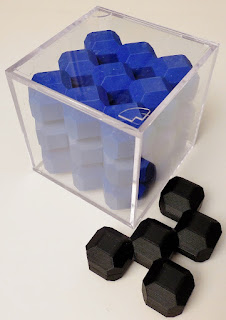
When the puzzle arrived, it had pieces nicely packed in a display case.  On close inspection, the packing appeared trivial.  I was able to take them out, mix them up, and put them back into the display case easily.  I also discovered that there were many solutions.  It will be a couple of years before this one will stump me – hopefully.

Hold on – there’s another piece in the shipping box that it came in.  Surely, it doesn’t go in the case with the other 9 pieces.  Since it’s bigger and oddly shaped, maybe it’s supposed to replace one or two of the other pieces.  However, having worked with a puzzle or two and the fact that the word melting is in the name, I suspected that the additional piece had to be crammed in the case with the other pieces.  You may be tempted to just torch that F’n piece and drip it in between the other pieces, but as puzzlers we’re all about doing things the hard way.

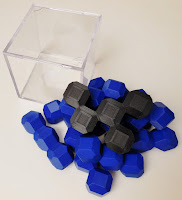
Melting F was made by geometric puzzle packing genius, George Bell, and was his entry in the 2020 Nob Yoshigahara Puzzle Design Competition.  This new design is a truncated rhombic dodecahedra packing exercise.  The puzzle consists of 10 3-D printed pieces that need to be packed within a clear acrylic display case.  The 9 identical blue pieces are made from 3 truncated rhombic dodecahedra while the single F piece is made from 5.  You have to squint really hard to convince yourself it looks like an F.

Melting F Pieces
The initial step with these types of puzzles is to determine the type of packing used – in this case, how the truncated rhombic dodecahedra are oriented within the space defined by the display case.  This then defines how the pieces can be oriented within the case.  Then comes the hard part – determining where the pieces have to go.  Although this is not overly difficult, it does take some experimentation to find the solution.

I liked the fact that nine of the pieces were simple identical shapes.  It drops the level of complexity and makes the design approachable for any level of puzzler.  It also displays nicely in the clear acrylic display case.  Melting F can be acquired from George’s PolyPuzzles Etsy Shop when in stock.